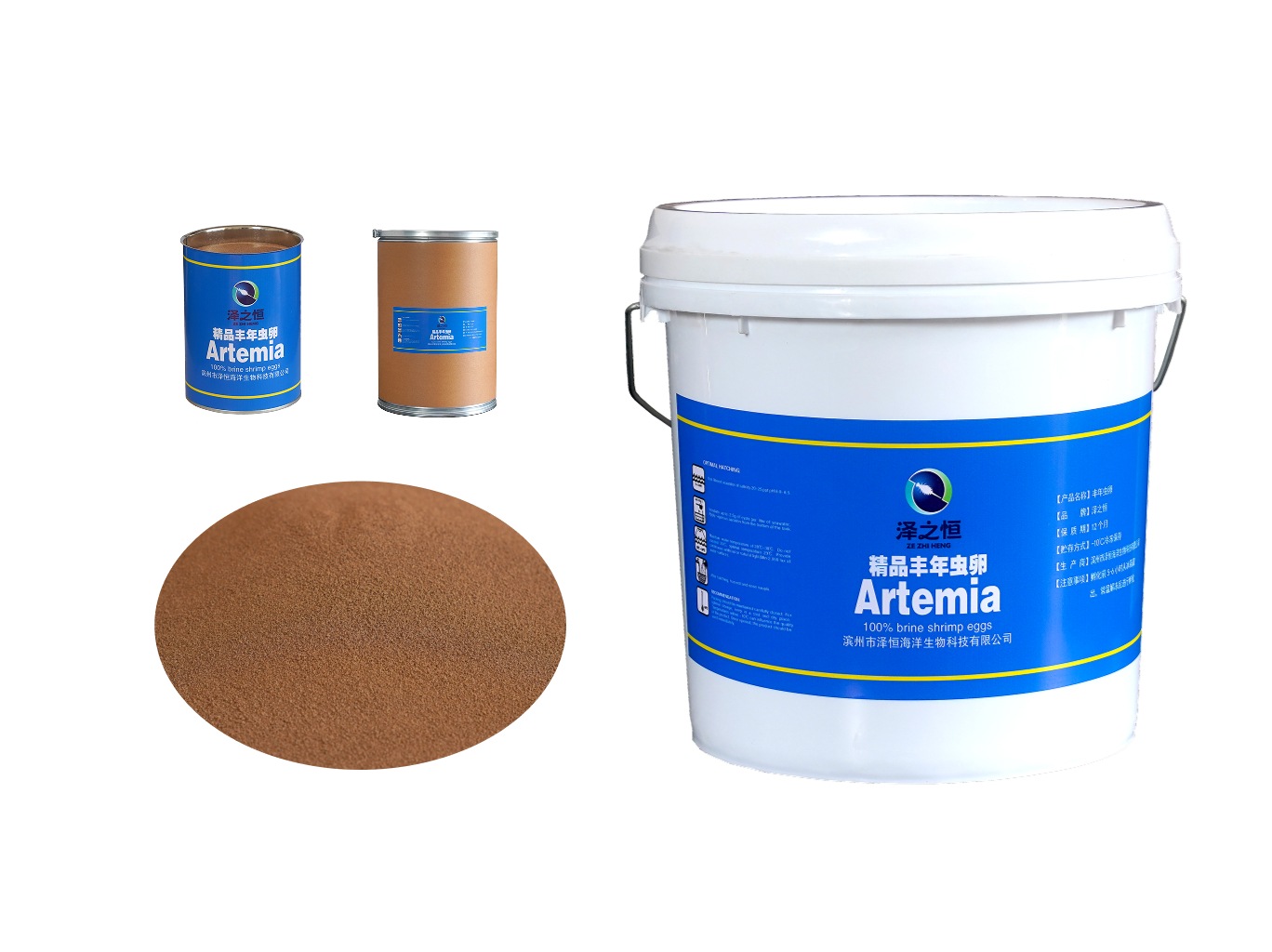
Brine Shrimp Eggs for Hatching (Decapsulate Before Hatching)
Product Overview
Brine Shrimp Eggs for Hatching (Decapsulate Before Hatching) are Artemia cysts that have had the hard outer shell removed under controlled conditions, while keeping the embryo inside alive.
When placed in water with suitable salinity and temperature, they hatch into large numbers of nauplii within 24–36 hours. Because the shell has been removed, there are almost no hard shell residues in the hatching water, which makes the system cleaner and easier to manage.
Main applications:
– Live feed for marine fish larvae, shrimp larvae, crab larvae, fry and filter-feeding organisms
– Raw material for aquaculture feeds, live-feed products and research use
Key Features and Advantages (vs. conventional brine shrimp eggs)
Disinfection;
Preventing water quality contamination;
Increasing the hatching rate;
Increasing the energy of nauplii by 30%;
No need to separate eggshells, making production more convenient;
Utilization of Artemia eggs/cysts that have no hatching ability.
Technical Specifications and Quality Standards
1. Raw Material and Typical Proximate Values
| Indicator | Typical Value* |
|---|---|
| Raw material | High-grade salt-lake Artemia cysts |
| Nominal hatching rate | ≥ 80% (under recommended conditions) |
| Cyst count | Approx. 230,000–260,000 eggs per gram |
| Crude protein | Approx. 55–65% (dry matter) |
| Crude fat | Approx. 6–20% (dry matter, depending on origin and batch) |
| Ash | In line with aquaculture industry standards |
| Moisture | ≤ 13% |
| Impurities | < 0.1% (shell fragments, sand, dust) |
| *Typical values for this type of product; actual values may vary slightly between batches. Please refer to the COA for exact data. | |
2. Microbiological and Safety Parameters
– Total plate count: controlled according to in-house specifications
– Vibrio spp. and other indicator bacteria: batch sampling and testing; compliant with relevant regulations or contractual requirements
– Optional: heavy metals (Pb, Cd, Hg, As, etc.) and other customer-specified items can be tested and reported on request
How to Choose Hatch Rate and Temperature
Our decapsulated brine shrimp eggs are produced from premium Artemia cysts sourced from salt lakes in China, Kazakhstan, Uzbekistan, and Russia. Artemia from different lakes have slightly different “comfort zones” for temperature. Based on long-term production data, we classify our products into 2 hatch rate grades and 3 temperature ranges, giving you up to 6 practical combinations to match your real farming conditions.
1. First, choose the hatch rate grade
≥85% Hatch Rate
Best balance of cost and stability
Recommended for: daily large-scale hatcheries and farms where unit cost is important
Typical use: routine production of marine fish, shrimp, and crab larvae in early stages
≥90% Hatch Rate
For users who want higher output per gram and more consistent batch performance
Recommended for: marine fish, vannamei shrimp, crab, and other species during critical early larval stages, or for broodstock and high-grade fry
Advantage: under the same feeding rate and operating conditions, you get more usable nauplii per gram, making it easier to calculate “nauplii per gram” and real unit cost
Note: Both hatch rate grades use high-quality salt lake Artemia cysts. The classification into ≥85% or ≥90% is based on actual performance under standard conditions, to ensure that the declared hatch rate is reliably achieved for each grade.
2. Then, choose the temperature range according to your water temperature
Our 24 °C ±1, 28 °C ±1, and 31 °C ±1 temperature ranges are not just laboratory “test temperatures”. Just like the hatch rate grades, they are based on the real performance of raw materials from different lakes. In other words, you are choosing a product type that is truly adapted to your working temperature range.
Low Temperature Type – around 24 °C (24 °C ±1)
Suitable water temperature: around 23–25 °C
Recommended for: cooler regions, spring/autumn production, or systems with intentionally lower water temperatures
Feature: maintains good hatch performance and nauplii vitality at relatively low temperatures
Standard Temperature Type – around 28 °C (28 °C ±1)
Suitable water temperature: around 27–29 °C
Recommended for: most standard marine hatcheries and nursery systems
Feature: the most universal choice, ideal as a default option if your process temperature is close to 28 °C
High Temperature Type – around 31 °C (31 °C ±1)
Suitable water temperature: around 30–32 °C
Recommended for: tropical/subtropical areas, high-density hatch systems, or situations where cooling water is difficult or expensive
Feature: designed to keep stable hatch performance at higher temperatures
3. How to think about the 6 possible combinations
With 2 hatch rate grades (≥85%, ≥90%) and 3 temperature ranges (24 / 28 / 31 °C), you can in principle choose from 6 different product types. Here is a quick way to decide:
If cost control is your priority (daily mass production)
Recommended: ≥85% + 28 °C (Standard Temperature Type)
If your system runs consistently cooler or hotter, choose:
≥85% + 24 °C (Low Temperature Type), or
≥85% + 31 °C (High Temperature Type)
If performance & output per gram are your priority
Recommended: ≥90% + the temperature range closest to your actual water temperature (24 / 28 / 31 °C)
Ideal for critical larval stages, high-value species, or users who require very stable batch-to-batch performance
4. Not sure what to choose?
When placing an order, you can also select “Not sure, please recommend” and tell us briefly:
Your species and stage (e.g. vannamei shrimp larvae, marine fish larvae, crab larvae, etc.)
Your real working water temperature range (e.g. 26–28 °C or 30–32 °C)
Your scale of use and whether you care more about cost or maximum nauplii output per gram
Our technical team will recommend the most suitable hatch rate grade + temperature range combination based on the raw material lake origin, current batch performance, and your farming conditions – helping you achieve stable hatch results and optimal cost-effectiveness in your system.
Recommended Hatching Conditions (reference ranges)
Reference the “Hatching Conditions for Brine Shrimp Eggs” section on the Brine Shrimp Eggs page.
Hatching Procedure
Hydration: First place dried brine shrimp (Artemia) cysts into the hatching solution to hydrate. This process usually lasts about 1 hour, and air aeration is required to prevent the cysts from settling to the bottom so they can absorb water fully.
Decapsulation: Add a decapsulation solution to the hydrated cysts (usually mainly sodium hypochlorite and sodium hydroxide). Stir and aerate at low temperature (e.g., 0–4 °C) to carry out the reaction. The cyst color changes from brown to gray-white, and finally becomes orange-red, indicating complete decapsulation. This step typically takes 10–20 minutes.
Rinsing and dechlorination: After decapsulation, collect the decapsulated eggs with a sieve and rinse thoroughly with a large amount of clean water. Then treat with a dechlorinating agent (such as sodium thiosulfate solution) to remove residual sodium hypochlorite and ensure the cysts are safe.
Hatching: Put the treated decapsulated eggs into the hatching solution, set the appropriate hatching conditions, and hatch for 24 hours to obtain nauplii.
Frequently Asked Questions (FAQ)
Q1: What is the difference between this product and decapsulated brine shrimp eggs (non-hatching)?
A1: This product is “decapsulated but hatchable”; the embryos remain alive and will hatch into nauplii under suitable conditions, making it ideal for live feed production. Non-hatching decapsulated eggs have embryos that are intentionally killed during processing and can only be used as a dry or formulated feed ingredient.
Q2: What factors have the biggest impact on hatching rate?
A2: The main factors are the original cyst quality, storage conditions and the actual hatching operation. Salinity, temperature, pH and aeration must be within the recommended ranges, and the product should be kept cool and dry. Long-term exposure to high temperature or humidity will reduce hatching rate.
Q3: Should I test small batches before large-scale use?
A3: Yes. It is strongly recommended to perform small-scale test hatches before full-scale use, record the hatching rate and the number of nauplii per gram under your own water and system conditions, and then use these data as the basis for process design and cost calculation.
 English
  Español
  Tiếng Việt
  Bahasa Indonesia
  ไทย
ไทย  Bahasa Melayu
  বাংলা
বাংলা  Nederlands
  Italiano
  Français
  Deutsch
  العربية