

Have you ever tried this—
putting brine shrimp eggs directly into a cup of tap water and waiting for them to hatch?
Or maybe you’ve wondered:
“Since they’re aquatic animals, isn’t water alone enough? Is salt really necessary?”
Many first-time hatching failures happen because people overlook this crucial question.
Some people see the eggs slowly swelling in water and assume they are about to hatch.
But after two or three days, not a single shrimp appears.
The problem is not the eggs — it’s the water.
Brine shrimp eggs are far more “selective” about their environment than most people realize.
Salt is not just a simple additive — it is the core condition that determines whether the life process can begin.
So—
Why must it be salt water?
Let’s start with the science behind it.
The Science Behind Why Brine Shrimp Eggs Need Salt Water
① Salt Controls Water Balance
You can think of a brine shrimp egg as a very tiny “water balloon.”
If you place it in pure freshwater, water rushes in rapidly. Internal pressure becomes unstable, the structure is damaged, and development stops.
In salt water, however:
Water exchange between the inside and outside remains balanced
Water absorption happens slowly and in a controlled way
The embryo can begin normal development
Salt is not just helpful — it is the key factor that controls the entire activation mechanism.
② Salt Acts as a “Start Signal”
Brine shrimp eggs can remain dormant for a very long time in a dry state.
But they do not hatch randomly.
Only when the surrounding salinity reaches an appropriate level does the embryo begin its development process. Salinity works like a “safety signal”:
✔ Proper salinity → hatching can begin
✘ Incorrect salinity → continued dormancy or failure
Without sufficient salt, the nutrients stored inside the egg cannot be properly utilized, and the hatching process simply cannot proceed.
③ This Is the Result of Natural Evolution
Brine shrimp naturally live in highly saline environments such as salt lakes and salt flats.
Requiring salt water for hatching is actually a survival strategy.
Why?
Because in saltwater environments:
There are fewer predators
There is less competition
Survival rates are higher
If they could hatch freely in freshwater, they would be far more vulnerable to predation.
Needing salt water to hatch is a protective mechanism developed through long-term evolution.
What Happens If You Break the Rules?
Theory alone isn’t enough — we conducted comparison experiments.
Experiment 1: Pure Freshwater Hatching

Condition: Clean freshwater, observed for 72 hours.
Results:
Eggs visibly swelled
Not a single egg hatched
Some shells collapsed
Conclusion: Freshwater cannot trigger normal development.
Experiment 2: Regular Table Salt vs. Non-Iodized Sea Salt

Comparison:
Non-iodized sea salt: 85%–90% hatch rate
Regular iodized table salt: below 10% hatch rate
Reason:
Regular table salt contains iodine and anti-caking agents, which can interfere with embryo development.
Conclusion: Not all salt is suitable.
Experiment 3: Low-Salinity Environment

Salinity was only half of the recommended level.
Results:
A small number of eggs hatched
Hatching time extended beyond 48 hours
Larvae showed weaker vitality
Conclusion: Salinity that is too low reduces both hatching speed and quality.
Experiment 4: Extremely High Salinity

Salt concentration was far above the recommended range.
Results:
Some eggs were able to hatch
Larvae died quickly afterward
Conclusion: Too much salt also affects survival.
More salt does not mean better results — it must stay within a proper range.
Ideal Hatching Conditions: It’s Not Just About Salt
Salt water is the foundation, but achieving a high hatch rate requires additional conditions.
① Proper Salinity
Recommended salinity: 20–30 ppt
(Specific gravity approximately 1.018–1.025)
Simple mixing method:
1 liter of water
20–30 grams of non-iodized sea salt
Avoid:
Iodized table salt
Salt with anti-caking additives
Untreated tap water (not dechlorinated)
② Temperature
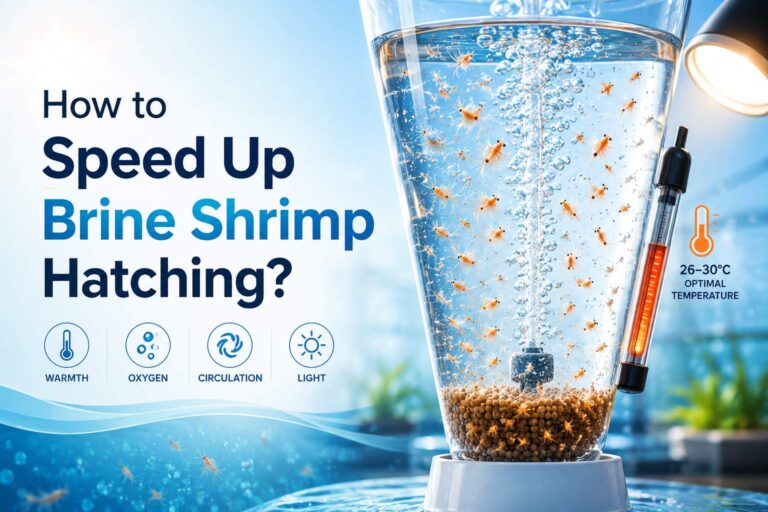
Optimal temperature: 26–30°C
At around 28°C, most eggs hatch within 24 hours.
Low temperature → slower hatching
High temperature → higher risk of larval death
③ Light
Continuous light improves hatch rates.
In completely dark conditions, hatching efficiency decreases noticeably.
④ Aeration (Oxygen Supply)
Strong aeration helps to:
Keep eggs suspended
Provide sufficient oxygen
Improve hatch success rate
Without enough oxygen, hatch rates drop significantly.
⑤ pH Level
Ideal range: around 8.0
Properly mixed saltwater usually reaches this range naturally, without complicated adjustments.

FAQ
Why is my hatch rate so low?
The most common reasons are:
Using the wrong type of salt (iodized salt)
Incorrect salinity
Temperature too low
Insufficient aeration
Check these factors one by one — most problems can be solved this way
Can brine shrimp eggs hatch in freshwater?
No, brine shrimp eggs cannot hatch in freshwater.
In pure freshwater, the eggs absorb water too quickly, internal pressure becomes unstable, and development stops. While the eggs may swell, they will not hatch successfully. Brine shrimp require a specific salt concentration to activate normal embryo development.
Can brine shrimp eggs hatch in tap water?
Not successfully.
Tap water is usually freshwater and does not contain the required salinity for hatching. In addition, untreated tap water may contain chlorine or other chemicals that further reduce hatch rates. Properly mixed saltwater is necessary for consistent results.
Do brine shrimp eggs need salt water to hatch?
Yes. Salt water is essential.
Salt controls water balance inside the egg and acts as the biological “start signal” for development. Without proper salinity, the embryo remains dormant or fails completely.
Can water be too salty for brine shrimp?
Yes.
Extremely high salinity can allow some eggs to hatch, but survival rates drop significantly. Larvae often die shortly after hatching. More salt does not improve results — it must stay within the recommended range.
Can I use table salt to hatch brine shrimp?
Regular iodized table salt is not recommended.
It often contains iodine and anti-caking agents, which can interfere with embryo development. Non-iodized sea salt or aquarium salt is a safer and more reliable choice.
Can you use Epsom salt to hatch brine shrimp?
No, Epsom salt is not suitable.
Epsom salt is magnesium sulfate, not sodium chloride. Brine shrimp require a proper saltwater environment similar to natural saline lakes, which Epsom salt alone cannot provi
Summary and Action Steps
You now understand:
✔ Brine shrimp eggs must be hatched in salt water
✔ Salinity must stay within a proper range
✔ Not all salt is suitable
✔ Temperature, light, and oxygen are equally important
Many hatching failures are not due to poor-quality eggs, but incorrect environmental conditions.
If you want consistent success, I recommend:
Use non-iodized sea salt
Maintain salinity at 20–30 ppt
Keep temperature around 28°C
Provide continuous strong aeration
 English
  Español
  Tiếng Việt
  Bahasa Indonesia
  ไทย
ไทย  Bahasa Melayu
  বাংলা
বাংলা  Nederlands
  Italiano
  Français
  Deutsch
  العربية