If you are hatching brine shrimp eggs for fish fry, aquarium feeding, aquaculture, or laboratory use, one of the first questions is simple:
How long does it take brine shrimp eggs to hatch?
In most normal hatching conditions, brine shrimp eggs usually hatch in about 24 to 36 hours. Under warmer and well-controlled conditions, some high-quality brine shrimp eggs may begin hatching in around 18 đến 24 giờ. If the water is too cold, the eggs are old, or the hatching setup is not stable, the process may take longer.
FAO describes dry Artemia cysts as hatching into free-swimming nauplii in 24–36 giờ, while aquaculture guidance commonly recommends warm water, proper salinity, light, and strong aeration for better hatching results.
Quick Answer: Brine Shrimp Egg Hatching Time
For most users, the practical answer is:
Brine shrimp eggs hatch in about 24 hours at 26–28°C / 80–82°F.
If the temperature is lower, hatching is slower. At around 21°C / 70°F, it may take closer to 36 hours. Many aquarium and aquaculture references also recommend avoiding excessively high temperatures, because overheating can reduce hatch quality or damage the nauplii.
A simple way to understand it:
| Water Temperature | Expected Hatching Time |
|---|---|
| 21°C / 70°F | Around 36 hours |
| 25°C / 77°F | Around 24–36 hours |
| 26–28°C / 80–82°F | Around 24 hours |
| 29–30°C / 84–86°F | Sometimes faster, but needs careful control |
Temperature is important, but it is not the only factor. Salinity, oxygen, light, egg quality, storage condition, and hatching density can all affect the final result.
Why Do Brine Shrimp Eggs Hatch at Different Speeds?
Brine shrimp eggs, also called Artemia cysts, are dormant embryos protected by a hard outer shell. When they are placed in suitable saltwater conditions, they absorb water, restart development, and eventually hatch into tiny free-swimming larvae called ấu trùng.
The hatching time can vary because cysts respond to their environment. Even if two batches are placed into water at the same time, they may not hatch at exactly the same speed if the temperature, oxygen, salinity, or egg quality is different.
Main Factors That Affect Brine Shrimp Egg Hatching Time
1. Temperature
Temperature is usually the biggest factor.
Brine shrimp eggs hatch faster in warm water than in cool water. Many practical hatching guides recommend a temperature range around 26–30°C, while some educational and aquaculture sources commonly mention 25–28°C as a suitable range.
If the temperature is too low, the eggs may still hatch, but they will hatch more slowly. If the temperature is too high, hatching may become unstable, and the nauplii may be weaker.
For most aquarium and aquaculture users, 26–28°C / 80–82°F is a practical target range.
2. Salinity
Brine shrimp eggs need saltwater to hatch properly. A common hatching range is around 25–35 ppt, although different protocols may use slightly different salinity levels depending on the purpose and strain of Artemia. Virginia Tech Extension lists 25–35 ppt as a hatching requirement, while UF/IFAS educational guidance gives a broader recommended range of 15–35 g/L.
If the salinity is too low or too high, the hatch rate may drop or the hatch time may become less predictable.
For most users, a practical formula is:
Use about 25–30 grams of non-iodized salt per liter of water.
This usually creates a suitable hatching environment for brine shrimp eggs.
3. Aeration and Oxygen
Brine shrimp eggs need oxygen during hatching. Strong aeration also keeps the eggs moving in the water, preventing them from settling at the bottom of the container.
If the eggs sink and stay in one place, many of them may not hatch well. Heavy, continuous aeration is commonly recommended in aquaculture hatching systems.
A good hatching setup should keep the eggs suspended, but not so violently that water splashes out or foam becomes excessive.
4. Light
Light can help stimulate hatching. Several hatching protocols recommend constant illumination during incubation, especially for commercial or laboratory-style hatching. Virginia Tech lists light level as one of the hatching requirements, and UF/IFAS also recommends strong illumination for brine shrimp cyst hatching.
For small aquarium users, placing a lamp near the hatchery is usually enough.
5. Egg Quality and Storage
Not all brine shrimp eggs hatch at the same rate. Fresh, high-quality eggs stored in a dry, cool, and sealed condition usually hatch better than old or poorly stored eggs.
If the eggs have been exposed to humidity, heat, or air for a long time, the hatch rate may decline. In that case, even if your water temperature and salinity are correct, the eggs may hatch slowly or unevenly.
This is why serious users often pay attention to:
- Hatch rate
- Egg origin
- Storage method
- Packaging condition
- Production batch
For fish farms, hatcheries, aquarium stores, and feed suppliers, stable hatch performance is more important than simply choosing the lowest price.
How to Tell If Brine Shrimp Eggs Have Hatched
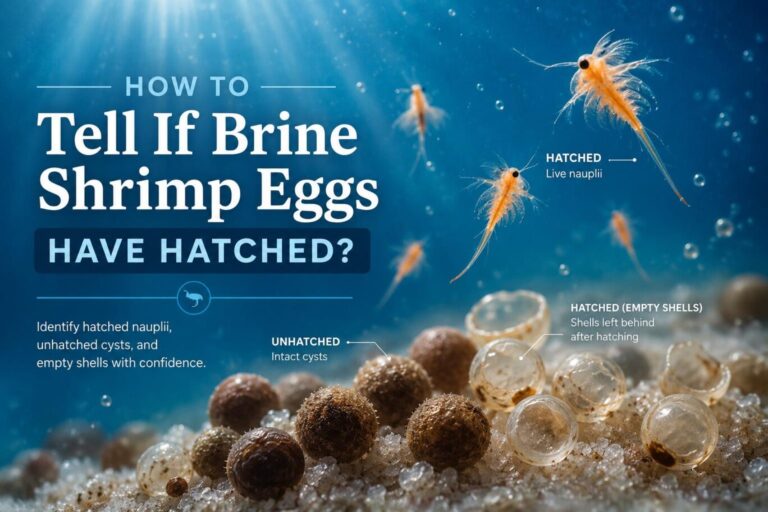
After about 18–24 hours, you may begin to see tiny orange or pinkish moving dots in the water. These are newly hatched brine shrimp nauplii.
You can usually identify successful hatching by checking:
- Tiny moving nauplii swimming in the water
- Empty eggshells floating near the surface
- Unhatched eggs or debris settling lower in the container
- A stronger orange color in the hatching water
Newly hatched nauplii are often attracted to light. Many users turn off the aeration for a few minutes and shine a light on one side of the container. The live nauplii gather near the light, making them easier to harvest.
Why Are My Brine Shrimp Eggs Not Hatching After 24 Hours?
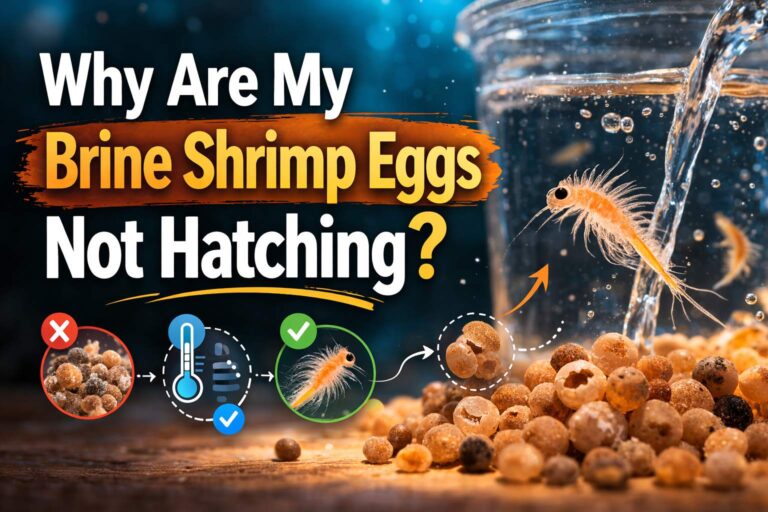
If your brine shrimp eggs have not hatched after 24 hours, it does not always mean the eggs are bad. First, check the hatching conditions.
Common reasons include:
The water is too cold.
At lower temperatures, hatching may take closer to 36 hours.
The salinity is wrong.
Too little or too much salt can reduce hatch performance.
There is not enough aeration.
Eggs need oxygen and movement.
The pH is too low.
Some hatching guides recommend alkaline water, often around pH 8.0 or higher.
The eggs were stored badly.
Heat, moisture, and oxygen exposure can reduce viability.
Too many eggs were added.
High egg density can reduce oxygen availability and make hatching less stable. Virginia Tech lists hatching density as one of the important requirements for Artemia hatching.
If nothing has hatched after 36–48 hours under correct conditions, the eggs may have low viability.
Best Conditions for Faster and More Stable Hatching
For most brine shrimp egg users, a simple hatching setup can follow these conditions:
| Factor | Practical Recommendation |
|---|---|
| Nhiệt độ | 26–28°C / 80–82°F |
| Hatching time | 24–36 giờ |
| Độ mặn | Around 25–35 ppt |
| pH | Around 8.0 or slightly higher |
| Aeration | Strong and continuous |
| Light | Continuous or strong light source |
| Mật độ trứng | Avoid overloading the hatchery |
These conditions do not guarantee that every egg will hatch, but they can help improve consistency and reduce common hatching problems.
When Is the Best Time to Harvest Brine Shrimp Nauplii?
The best harvest time is usually soon after most eggs have hatched, often around the 24-hour mark under warm and stable conditions.
Freshly hatched nauplii are more valuable as live feed because they still contain more internal nutrition from the egg. If you wait too long after hatching, the nauplii begin using their own energy reserves, and their nutritional value may decline unless they are enriched.
For feeding fish fry or larvae, many users prefer to harvest when the nauplii are newly hatched and still small enough for young fish to eat.
Do All Brine Shrimp Eggs Hatch at the Same Time?
No. Brine shrimp eggs usually hatch over a period of time, not all at once.
In a good batch, many eggs may hatch within a close window, but you may still see some eggs hatch earlier and others later. This is normal.
However, if the hatch is very uneven, it may indicate:
- Unstable temperature
- Poor aeration
- Mixed egg quality
- Old cysts
- Độ mặn không chính xác
- Overcrowded hatching conditions
For commercial users, more uniform hatching is important because it makes feeding schedules easier to control.
FAQ: Brine Shrimp Egg Hatching Time
How long do brine shrimp eggs take to hatch at room temperature?
At normal room temperature, brine shrimp eggs may take 24–36 giờ or longer, depending on how warm the room is. If the room is cool, hatching will be slower.
Trứng tôm nước mặn có thể nở trong nước ngọt không?
Brine shrimp eggs are normally hatched in saltwater. Freshwater is not suitable for normal Artemia cyst hatching.
Trứng tôm nước mặn có cần ánh sáng để nở không?
Light is strongly recommended. It can help stimulate hatching and also makes harvesting easier because nauplii are attracted to light.
Nhiệt độ nào là tốt nhất để ấp trứng tôm nước mặn?
A practical target is 26–28°C / 80–82°F. This range usually gives fast and stable hatching for many users.
Why do some brine shrimp eggs hatch in 18 hours?
Some high-quality eggs may hatch faster when temperature, salinity, oxygen, pH, and light are all well controlled. Research on Artemia hatching has shown that optimized conditions can shorten hatching time, but everyday users should still expect around 24–36 hours.
Conclusion: How Long Does It Take Brine Shrimp Eggs to Hatch?
Brine shrimp eggs usually take 24 to 36 hours to hatch. Under good conditions, many eggs hatch in about 24 giờ, especially when the water temperature is around 26–28°C / 80–82°F.
If you want better hatching results, do not focus only on time. Pay attention to the full hatching system: temperature, salinity, oxygen, light, pH, egg density, and egg quality.
For aquarium feeding, fish fry, hatcheries, and aquaculture use, choosing stable, high-quality brine shrimp eggs is just as important as using the right hatching method. A good batch of Artemia cysts can help you achieve faster hatching, better nauplii quality, and more predictable feeding results.

 English
  Español
  Tiếng Việt
  Bahasa Indonesia
  ไทย
ไทย  Bahasa Melayu
  বাংলা
বাংলা  Nederlands
  Italiano
  Français
  Deutsch
  العربية