Hatching brine shrimp eggs sounds simple: add saltwater, aeration, light, and wait. But after 18–36 hours, many people face the same question: have the brine shrimp eggs actually hatched, or am I just looking at shells and unhatched cysts?
This question matters because newly hatched brine shrimp, also called Artemia nauplii, are widely used as live feed for fish fry, shrimp larvae, and aquarium species. At the same time, unhatched eggs and empty shells should not be treated as the same thing as live nauplii. They can reduce feed quality and may even create problems if small fish or larvae ingest too many shells or unhatched cysts. FAO and aquaculture references note that unhatched cysts and empty shells are difficult to separate completely and may be harmful when ingested by larvae.
So, how can you tell if brine shrimp eggs have hatched? The answer is to look at movement, color, layering, and light response.
The clearest sign: tiny moving orange nauplii
The most reliable sign of successful hatching is movement.
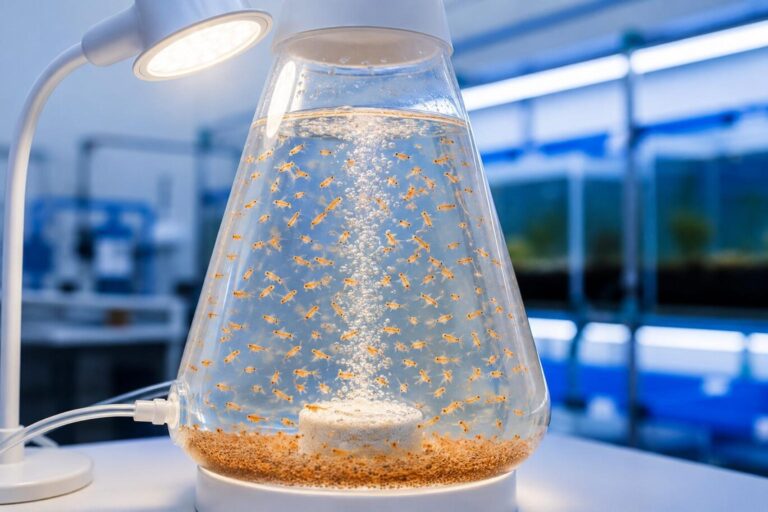
When brine shrimp eggs hatch, they release tiny baby brine shrimp called nauplies. These nauplii are very small, usually orange to reddish-orange, and they move in short, jerky swimming motions. Under strong light, they may look like tiny moving dots in the water.
If you shine a flashlight on one side of the hatchery, newly hatched brine shrimp often gather toward the light. This light attraction makes it easier to separate them from egg shells and unhatched cysts during harvesting. Educational and hatchery guides commonly describe nauplii concentrating near light while shells and unhatched eggs separate into different layers.
If you only see brown particles floating or sinking, but no active swimming movement, the eggs may not have hatched well yet.
What do hatched brine shrimp eggs look like?
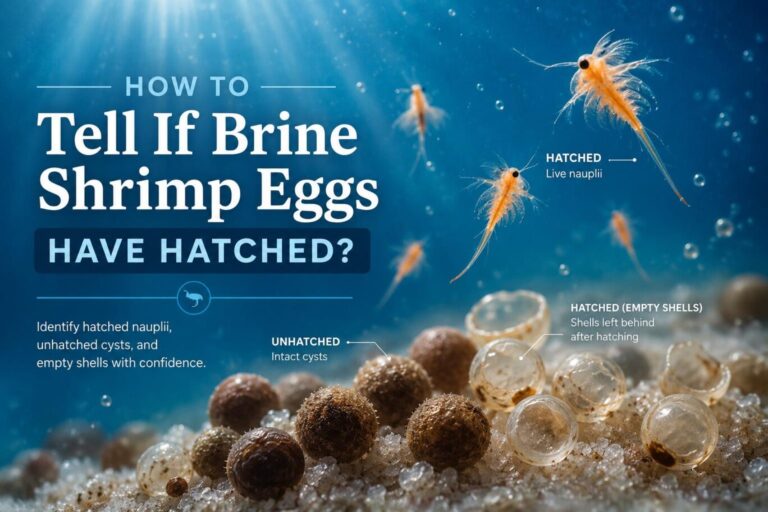
After hatching, the container usually contains three different things:
| What you see | What it probably is | Where it usually stays |
|---|---|---|
| Tiny orange moving dots | Live brine shrimp nauplii | Middle water area, often toward light |
| Light brown empty shells | Hatched egg shells | Often floating near the surface |
| Dark brown heavy particles | Unhatched eggs / cysts | Often settled at the bottom |
This layer separation is one of the easiest ways to judge the hatch. When aeration is turned off and the water becomes still for a few minutes, empty shells tend to float, unhatched eggs tend to sink, et live nauplii stay in the water column or move toward light.
This does not mean every hatchery will separate perfectly. Water movement, egg quality, salinity, container shape, and aeration strength can all affect how clearly these layers appear.
Simple test: turn off the air and use light
A practical way to check whether brine shrimp eggs have hatched is this:
- Turn off the air pump or aeration.
- Wait 3–5 minutes.
- Shine a small flashlight on the side or lower-middle part of the container.
- Watch whether tiny orange dots gather toward the light.
- Check whether shells float and dark cysts sink.
If you see many moving orange nauplii gathering near the light, the hatch has been successful.
If the water only contains floating shells and bottom debris, but very few moving nauplii, the hatch rate may be low. If most particles are still dark and sitting at the bottom, many eggs may remain unhatched.
Combien de temps faut-il pour que les œufs d'artémias éclosent ?
In many home aquarium or small hatchery setups, brine shrimp eggs often begin hatching within about 18–24 hours under suitable conditions. In colder water or less ideal conditions, hatching may take longer, sometimes closer to 36 hours.
However, timing alone is not enough. Some eggs may look “processed” because the shell color changes slightly, but that does not always mean the nauplii have emerged. The best confirmation is still visible live nauplii movement.
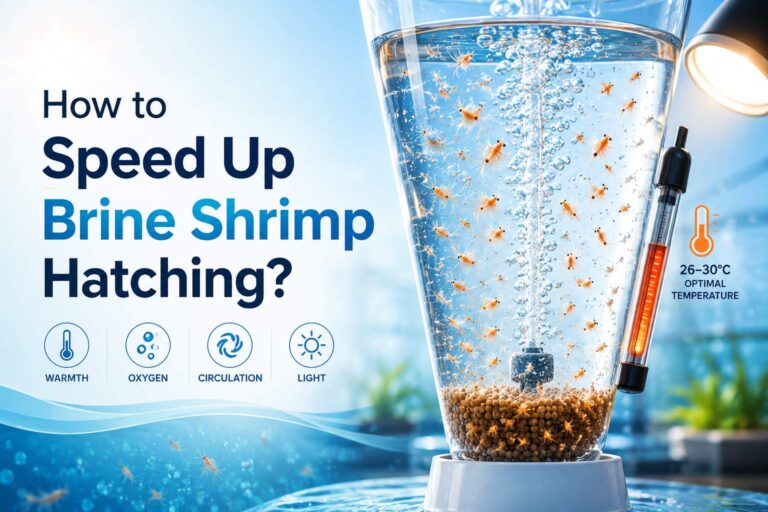
Several factors can affect hatching speed and hatch rate, including water temperature, salinity, oxygen, light, cyst quality, storage conditions, and cyst origin. Aquaculture references also note that hatching performance depends on water quality, circulation, and cyst origin.
How to tell the difference between live nauplii, shells, and dead eggs
Many beginners confuse empty shells with live brine shrimp. This is understandable because all three can look like tiny brown or orange particles.
Live nauplii
Live nauplii are active. They swim, twitch, and respond to light. They are usually orange or reddish-orange because of their natural pigments and yolk reserves. They do not simply float passively at the surface.
Empty shells
Empty shells are the outer casing left after hatching. They often look lighter, thinner, and more hollow than unhatched cysts. In still water, they usually rise toward the surface.
Unhatched eggs
Unhatched eggs are usually darker, heavier, and more solid-looking. They often sink to the bottom when aeration stops. These are not live feed and should be separated as much as possible before feeding.
For small fish fry and delicate larvae, clean separation is important because shells and unhatched cysts are not digestible and may cause feeding or digestive problems.
Pourquoi mes œufs d'artémias n'éclosent-ils pas ?
If you do not see moving nauplii after 24–36 hours, the problem may not be just “bad eggs.” Several conditions can affect hatching.
1. Water temperature is too low
Brine shrimp eggs hatch faster in warm water. If the water is too cool, hatching slows down or becomes uneven.
2. Poor aeration
Strong, continuous aeration helps keep cysts suspended and provides oxygen. If eggs sit at the bottom without movement, hatching may be poor.
3. Incorrect salinity
Brine shrimp eggs need saltwater. If salinity is too low or too high, hatch performance may suffer.
4. Old or poorly stored eggs
Brine shrimp cysts are sensitive to storage. Heat, moisture, and long exposure to poor conditions can reduce hatch rate.
5. Low-quality cysts
Not all brine shrimp eggs have the same hatch rate. Different origins, processing methods, and storage conditions can affect results.
6. Too many eggs in too little water
Overloading the hatchery can reduce oxygen and make the hatch dirty. This can lead to lower hatch rate and more debris.
What does a good hatch look like?
A good hatch usually has these signs:
- Many tiny orange nauplii moving actively
- Strong gathering response toward light
- Fewer dark unhatched cysts at the bottom
- Clear separation between floating shells and swimming nauplii
- Water that does not smell rotten or heavily polluted
- A large number of nauplii harvested from the middle water layer
A poor hatch usually looks different:
- Many dark eggs remain at the bottom
- Few or no moving orange dots
- A lot of floating shells but not many live nauplii
- Cloudy, dirty, or bad-smelling water
- Weak or no response to light
How to harvest only the hatched brine shrimp
Once you confirm that the eggs have hatched, do not pour the whole hatchery directly into the aquarium or larval tank.
A better method is:
- Turn off aeration.
- Wait a few minutes for separation.
- Use light to attract nauplii to one area.
- Siphon the orange nauplii from the middle water layer.
- Pass them through a fine mesh sieve.
- Rinse with clean saltwater or freshwater, depending on your feeding use.
- Feed immediately while the nauplii are still fresh and active.
This helps reduce the amount of empty shells and unhatched eggs entering the feeding tank.
Can unhatched eggs hatch later?
Sometimes, yes.
If some eggs remain unhatched after the first harvest, they may hatch later if conditions are still suitable. Some users continue aeration for another 12–24 hours to collect a second hatch.
However, the second hatch is often less clean and may contain more debris, weaker nauplii, or mixed-stage brine shrimp. For sensitive fry or professional aquaculture feeding, the freshest and cleanest hatch is usually preferred.
Why hatch rate matters when choosing brine shrimp eggs
For aquarium hobbyists, hatch rate affects convenience. For aquaculture hatcheries, it affects feeding efficiency, larval survival, labor cost, and production stability.
Higher-quality brine shrimp eggs usually provide:
- More live nauplii per gram of cysts
- Faster and more even hatching
- Less waste from unhatched eggs
- Cleaner harvesting
- More predictable feeding results
When buying brine shrimp eggs, it is useful to look beyond price alone. Hatch rate, cyst cleanliness, storage condition, origin, and supplier reliability all affect the real value of the product.
A cheaper product with poor hatch rate may actually cost more in daily use because more eggs are needed to produce the same amount of live nauplii.
Final answer: how to tell if brine shrimp eggs have hatched
You can tell brine shrimp eggs have hatched when you see tiny orange nauplii actively swimming in the water, especially when they gather toward a light source. After turning off aeration, empty shells often float near the surface, unhatched eggs sink to the bottom, and live nauplii remain in the water column or move toward light.
If there is movement, light response, and clear separation, the hatch is likely successful.
If most particles are still dark, motionless, and sitting at the bottom, the eggs have not hatched well yet.
For best results, always harvest the moving nauplii carefully and avoid feeding large amounts of shells or unhatched cysts to small fish or larvae. In brine shrimp hatching, the goal is not just to see “something in the water.” The real goal is to collect clean, active, newly hatched Artemia nauplii.
 English
  Español
  Tiếng Việt
  Bahasa Indonesia
  ไทย
ไทย  Bahasa Melayu
  বাংলা
বাংলা  Nederlands
  Italiano
  Français
  Deutsch
  العربية