
Producing Artemia cysts is not the same as hatching Artemia cysts.
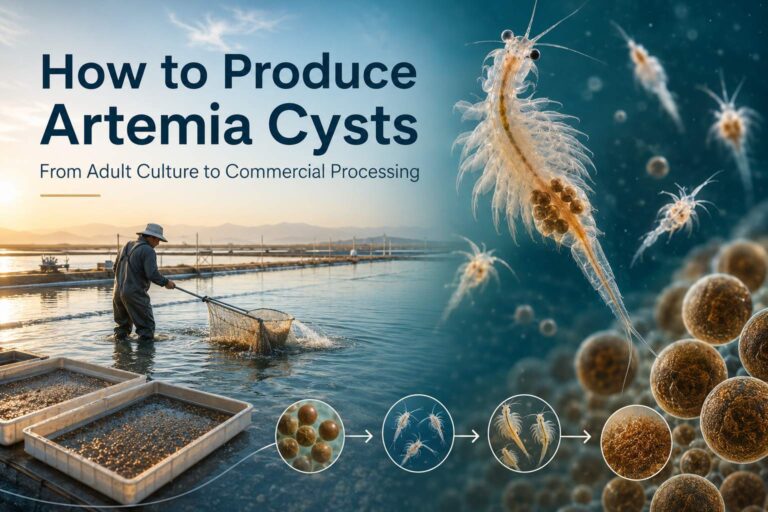
Hatching turns dormant cysts into live nauplii for feeding fish or shrimp larvae. Producing new cysts requires a much longer process: starter cysts are hatched, the nauplii are cultured to adulthood, mature females are encouraged to switch from releasing live nauplii to producing dormant embryos, and the harvested cysts are then cleaned, dehydrated, dried, graded and tested.
This distinction is important because a small hatching cone can produce live Artemia within approximately one day, but it cannot produce a meaningful quantity of new commercial cysts on its own.
Quick Answer: How Are Artemia Cysts Produced?
Artemia cyst production normally involves the following stages:
- Hatch high-quality starter cysts.
- Transfer the nauplii into a grow-out tank or hypersaline pond.
- Feed and grow the Artemia until they reach reproductive maturity.
- Maintain a healthy population of mature males and females.
- Gradually create conditions that favour oviparity, or cyst production.
- Collect floating cysts from the water surface.
- Separate the cysts from sand, salt, shells and organic debris.
- Dehydrate and dry the cysts under controlled conditions.
- Test hatchability, hatching efficiency, purity and moisture.
- Seal and store the finished cysts under cool, dry conditions.
Commercial production is generally conducted in natural salt lakes, solar salt ponds or purpose-managed hypersaline ponds. Tank production is possible for research and small-scale trials, but it is more difficult to operate economically at commercial volume.

Hatching Cysts and Producing Cysts Are Different Processes
The terms are frequently confused because both processes begin with Artemia cysts.
| Process | Starting Material | Final Output | Typical Duration |
|---|---|---|---|
| Artemia hatching | Dormant cysts | Live instar I nauplii | About 18–36 hours |
| Artemia grow-out | Nauplii | Juvenile and adult Artemia | Approximately 1–3 weeks |
| Artemia cyst production | Reproductive adults | Newly produced dormant cysts | Multiple reproductive cycles |
| Commercial processing | Raw harvested cysts | Clean, dry, tested cyst product | Several additional processing stages |
A hatchery that only needs live feed usually buys processed cysts and hatches them when needed. A cyst producer must manage the complete biological population as well as harvesting, drying, testing and storage.
Why Do Adult Artemia Produce Cysts?
Adult female Artemia have two main reproductive modes.
Under favourable conditions, females may release free-swimming nauplii. This is known as ovoviviparity.
When environmental conditions become unstable, females may instead produce embryos surrounded by a protective shell. These dormant embryos are the brown particles commonly called Artemia eggs or Artemia cysts. This reproductive mode is known as oviparity.
The switch is a survival strategy. Cysts can remain dormant through dehydration, high salinity and other unfavourable conditions, then resume development when suitable water, oxygen, temperature and light conditions return.
However, there is no universal switch that guarantees cyst production in every Artemia strain. Salinity, dissolved oxygen patterns, temperature, population density, food conditions, iron availability, strain genetics and the reproductive age of the females can all influence the outcome. Sudden environmental fluctuations appear to be especially important, but the biological mechanism is still not completely understood.
Can Artemia Cysts Be Produced in a Tank?
Yes, adult Artemia can produce cysts in controlled tanks. Laboratory studies have used tanks and air-water-lift raceways to examine how oxygen, salinity, iron and diet affect reproductive mode.
Tank production is useful for:
- Research and strain comparison
- Producing experimental batches
- Maintaining broodstock
- Learning Artemia population management
- Testing feeds and environmental conditions
It is usually not the most economical way to produce large quantities of commercial cysts. Tank systems require continuous feeding, aeration, water-quality management, harvesting labour and controlled processing. A small aquarium may produce some cysts, but the yield and hatch quality are likely to be inconsistent.
Large-scale commercial production is more commonly associated with salt lakes or shallow solar salt ponds, where salinity, natural food production, evaporation and wind-assisted cyst concentration can be managed more efficiently.
Step 1: Define the Production Goal
Before starting, decide whether the objective is:
- A small experimental cyst batch
- Broodstock maintenance
- Local production for one hatchery
- Integrated Artemia and solar-salt farming
- Commercial cyst production for external customers
This decision determines the required pond area, water supply, strain, feed system, harvesting equipment, laboratory capability and processing method.
A hatchery that consumes only a moderate quantity of cysts may find that in-house production costs more than purchasing standardized finished cysts. Producing cysts becomes more realistic when suitable hypersaline ponds, favourable weather, experienced labour and enough production volume are already available.
Step 2: Select Suitable Starter Cysts and a Production Strain
The original cyst batch determines the Artemia population established in the system. Strains can differ in:
- Temperature and salinity tolerance
- Adult growth and reproductive performance
- Cyst size
- Nauplius size
- Hatching synchrony
- Nutritional composition
- Suitability for the target fish or shrimp species
Use starter cysts with known origin, reliable hatch performance and good storage history. Poor-quality starter cysts can result in low population establishment, uneven age structure and weak reproductive output.
Introducing Artemia into an open pond or natural water body should also be evaluated carefully. Non-native Artemia strains may affect local hypersaline ecosystems, so local environmental and aquaculture regulations should be checked before inoculation.
Step 3: Hatch the Starter Cysts Correctly
Starter cysts must first be hatched into healthy nauplii.
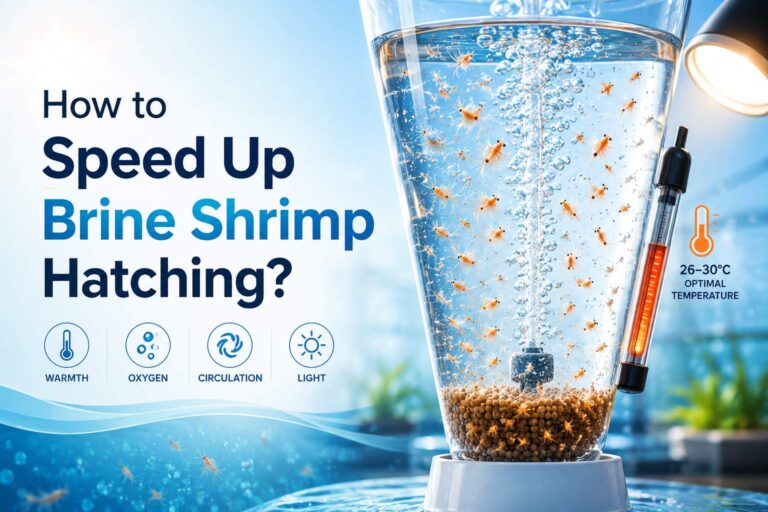
A commonly used professional hatching range is:
| Parameter | Typical Hatching Range |
| Température | 26–30°C |
| Salinité | 25–35 g/L |
| pH | 8.0–9.0 |
| Light | Approximately 2,000 lux |
| Cyst density | Up to about 2 g/L for shell-on cysts |
| Dissolved oxygen | Maintain above approximately 4 mg/L |
| Incubation | Usually 18–24 hours, depending on strain and batch |
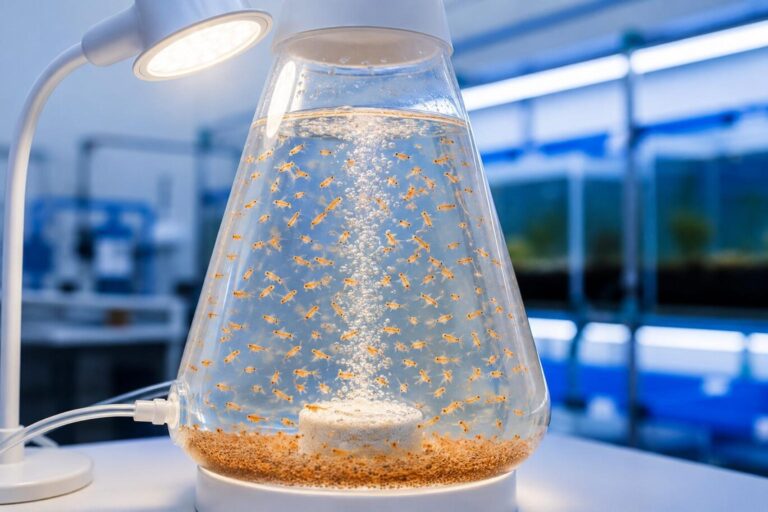
Use a clean cone-bottom tank with vigorous bottom aeration. The aeration should keep all cysts suspended without allowing dead zones to form.
Do not reduce oxygen during hatching. Low or fluctuating oxygen may be studied as a reproductive stimulus for adult Artemia, but developing embryos and newly hatched nauplii require adequate oxygen.
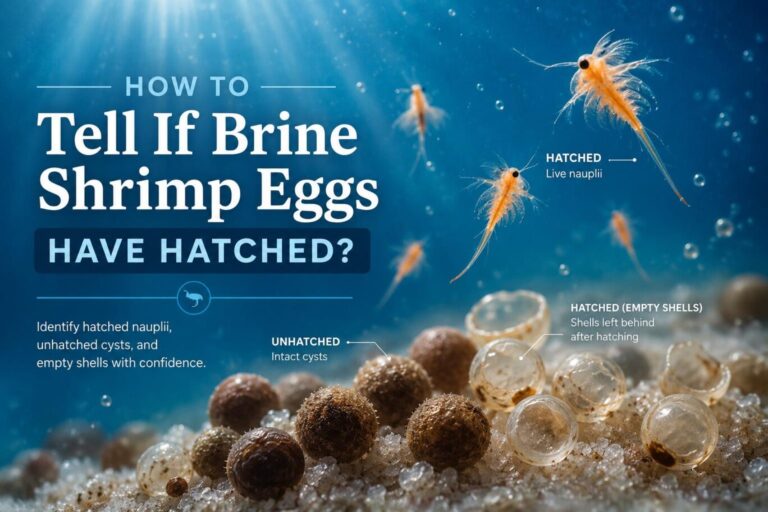
After hatching, separate the nauplii from empty shells and unhatched cysts, rinse them with clean water and transfer them promptly to the grow-out system.
Step 4: Prepare the Grow-Out Pond or Tank
The culture system must support Artemia from the nauplius stage to reproductive adulthood.
Important requirements include:
Saline Water
Artemia require saline water for normal growth and reproduction. The exact operating range depends on the strain and production model.
A cyst-oriented pond is often managed at a higher salinity than a biomass-oriented system. In practical pond production, salinities of approximately 80–120 g/L are often associated with increased cyst production, while lower salinity combined with abundant food may favour population growth and biomass production.
Salinity should normally be changed gradually. Abruptly transferring young Artemia into extreme salinity can cause mortality before a reproductive population is established.
Suitable Pond Depth and Circulation
Commercial salt ponds are normally shallow enough to support natural productivity and practical management, but deep enough to reduce extreme daily temperature changes.
Tank systems require sufficient circulation to keep food particles available and prevent waste accumulation. Air-water-lift or raceway designs can improve mixing without mechanically damaging the Artemia.
Predator and Competitor Control
Fish, insects and other predators can rapidly reduce an Artemia population. Incoming water should be screened, and the production pond should be inspected regularly.
Stable Water Quality
Monitor at least:
- Salinité
- Température
- Dissolved oxygen
- pH
- Water transparency
- Algal condition
- Artemia density
- Population age structure
- Percentage of reproductive females
The objective is not merely to keep Artemia alive. It is to maintain enough healthy adults to produce repeated broods.
Step 5: Feed the Artemia to Reproductive Maturity
Artemia are non-selective filter feeders. Depending on the system, they may consume:
- Dunaliella and other microalgae
- Spirulina-based diets
- Rice bran
- Yeast
- Soybean-based feeds
- Formulated microparticle diets
- Biofloc and suspended organic particles
Natural green-water systems can reduce feed costs, but productivity must be monitored. A pond that becomes too clear may not contain enough suspended food, while excessive feeding may increase oxygen demand, produce ammonia and encourage undesirable microbial growth.
The feed particles must remain small enough for Artemia to filter. Large particles settle and become organic waste instead of useful feed.
The Artemia may begin reproducing roughly 10–21 days after inoculation under suitable conditions, although development time varies with temperature, strain, salinity, food and stocking density. In some pond systems, mating pairs are observed around days 7–10 and reproduction may begin from days 10–15 onward.
Step 6: Build a Stable Reproductive Population
Do not begin severe stress immediately after hatching.
The population first needs:
- Adequate numbers of adults
- Mature females with developed ovaries
- A balanced age structure
- Sufficient food reserves
- Acceptable survival
- Suitable male-to-female availability in bisexual strains
Many populations produce live nauplii during their first reproductive cycles and shift progressively toward cyst production later. Field behaviour is variable, so the reproductive condition of the females should be observed rather than relying only on the number of days after stocking.
A microscope or hand lens can help distinguish:
- Immature females
- Females carrying developing nauplii
- Females carrying brown cysts
- Empty reproductive sacs
- Stressed or poorly fed adults
Step 7: Encourage the Shift Toward Cyst Production
The objective is to favour oviparity without destroying the reproductive population.
Gradually Increase Salinity
Evaporation or controlled addition of concentrated brine can gradually raise salinity. In many pond systems, approximately 80–120 g/L favours cyst production, but the effective range remains strain- and climate-dependent.
Extremely high salinity is not automatically better. If salinity rises faster than the Artemia can acclimate, adult survival and brood size may decline.
Create Controlled Oxygen Fluctuations
Research has linked cyclic oxygen stress with increased oviparity. In one controlled study, discontinuous aeration produced a higher percentage of cyst-producing females than continuous aeration.
This does not mean that the pond should be kept permanently hypoxic. Prolonged low oxygen can kill adults, reduce feeding and collapse the population. Any oxygen fluctuation should be gradual, monitored and followed by recovery.
Maintain Appropriate Iron and Food Sources
Iron associated with microalgae and chlorophyll has been linked to haemoglobin and cyst-shell formation. A productive green-water system may therefore support the biological processes involved in oviparity.
Food limitation may contribute to the reproductive shift, but deliberate starvation is risky. Severe food shortage reduces fertility and removes younger age classes, leaving an ageing population with declining total production.
A better strategy is to combine moderate environmental fluctuations with continued maintenance of adult health.
Monitor the Females
The most reliable indication is the actual reproductive condition of the females. Increasing salinity without observing the population may produce high mortality rather than high cyst yield.
Record:
- Percentage of females carrying cysts
- Number of reproductive females
- Adult survival
- Brood frequency
- Food availability
- Salinity and oxygen changes
- Quantity of cysts collected each day
This creates a production record that can be used to refine the protocol for the specific strain and site.
Step 8: Harvest the Floating Cysts
Freshly released cysts usually float in hypersaline water. Wind moves them toward the downwind bank or corners of the pond, where they mix with foam and organic debris.
Harvest frequently, preferably every day during active production. Delayed collection exposes the cysts to rainfall, repeated hydration, intense heat, contamination and mechanical damage.
A fine scoop net or collection screen of approximately 100–150 µm can be used. Avoid scraping the pond bottom, because sand and heavy debris increase the processing workload and may damage equipment.
Keep separate records for:
- Pond number
- Harvest date
- Wet weight
- Salinité
- Weather
- Population condition
- Raw material appearance
Lot separation at this stage improves traceability later.
Step 9: Carry Out Primary Brine Processing
Raw harvested material contains full cysts, empty shells, sand, salt crystals, feathers, plant material and other organic particles.
Saturated brine is commonly used for initial density separation:
- Place the raw material in a conical processing tank.
- Add saturated brine.
- Mix with aeration for several minutes.
- Stop aeration and allow heavy debris to settle.
- Allow cysts and light material to float.
- Discharge heavy debris through the bottom valve.
- Repeat the process when necessary.
- Collect the floating cyst fraction.
Saturated brine both improves flotation and begins dehydrating the cysts. The separation step must be standardized because prolonged handling or aggressive mixing can lower the quality of fragile batches.
Step 10: Wash, Separate and Disinfect the Cysts
After brine processing, the cysts may undergo freshwater processing.
A typical workflow includes:
- Removal of excess brine
- Freshwater density separation
- Controlled disinfection when required
- Rinsing through approximately 150 µm screens
- Removal of remaining debris
- Removal of excess water by cloth bags, spin drying or controlled centrifugation
In freshwater density separation, high-density full cysts normally sink while lighter empty shells and low-quality material remain nearer the surface. The fractions can be processed separately into different grades.
Do not use excessively high centrifugal force or excessively long centrifugation. Mechanical damage and clumping make later drying less uniform.
Step 11: Dehydrate and Dry the Cysts
Drying is one of the most critical stages in commercial cyst production.
The goal is to remove enough moisture to preserve viability without overheating or physically damaging the embryos.
Important principles include:
- Dry the product rapidly and uniformly.
- Keep product temperature generally below approximately 35°C.
- Avoid thick, uneven layers.
- Prevent cysts from forming wet clumps.
- Continue drying until moisture is below approximately 10%.
- Cool the cysts before final sealing.
If part of a batch remains above 10% moisture, hatching output and shelf life may decline. Excessively high drying temperature can also damage the embryos.
Small producers have historically used sun drying, but weather-dependent drying is difficult to standardize. Controlled tray dryers or fluidized-bed dryers generally provide better temperature control, airflow and batch uniformity.
Step 12: Grade and Test the Finished Cysts
Finished Artemia cysts should not be evaluated by hatch percentage alone.
A commercial quality-control programme should consider:
Hatching Percentage
The percentage of full viable cysts that release nauplii under standardized test conditions.
Hatching Efficiency
The number of nauplii produced per gram of dry commercial product.
Hatching efficiency is particularly important for buyers because it includes the influence of purity and cyst count. Two batches can have a similar hatch percentage but produce different numbers of nauplii per gram.
Hatching Rate or Synchrony
The time distribution between the first and final hatch. A narrow hatch window supports predictable feeding schedules and more uniform instar I nauplii.
Moisture Content
Excess moisture reduces storage stability and can activate metabolism prematurely.
Impurity Level
Sand, salt, empty shells and organic debris add weight without producing usable nauplii.
Nauplius Size
Different fish and crustacean larvae have different mouth-gape requirements. Smaller nauplii may be more suitable for delicate early-stage larvae.
Shell Separation
Easy separation reduces labour and lowers the risk of shells entering larval tanks.
Microbiological Condition
Cyst surfaces and hatching water can introduce bacteria into a hatchery. Production hygiene, disinfection and storage therefore affect more than appearance.
Batch Traceability
The final lot should remain linked to its origin, harvest date, processing records, test results and packaging date.
Modern quality evaluation commonly includes cyst count, hatching percentage, hatching efficiency, hatching rate, moisture, cyst diameter and nutritional characteristics of the resulting nauplii.
Step 13: Package and Store the Cysts
Immediately after drying and cooling, cysts should be placed in airtight packaging to prevent rehydration.
Commercial options include:
- Vacuum-sealed cans
- Nitrogen-flushed cans
- Airtight laminated bags
- Sealed bulk containers with moisture barriers
Store finished cysts in a cool, dry environment. The updated FAO guidance recommends cool storage below approximately 10°C for processed dry cysts. Opened packaging should be resealed promptly because Artemia cysts are hygroscopic and absorb moisture from the air.
Common Artemia Cyst Production Mistakes
Mistake 1: Treating Hatching as Cyst Production
A cone full of newly hatched nauplii is only the beginning. New cysts cannot be obtained until Artemia reach reproductive adulthood.
Mistake 2: Applying Severe Stress Too Early
Young Artemia must first establish a healthy population. Early extreme salinity or oxygen stress usually causes mortality rather than cyst production.
Mistake 3: Assuming More Stress Produces More Cysts
Excessive stress reduces feeding, fertility, brood size and adult survival. Controlled fluctuation is different from continuous poor water quality.
Mistake 4: Starving the Population
Moderate food limitation may influence reproductive mode, but prolonged starvation reduces total reproductive output and destabilizes the population.
Mistake 5: Collecting Cysts Infrequently
Rain, condensation and repeated hydration can reduce viability. Frequent collection also limits contamination.
Mistake 6: Drying Too Hot or Unevenly
A batch can appear dry on the outside while retaining damaging moisture inside clumps. Temperature and final moisture must be verified rather than estimated visually.
Mistake 7: Selling Only by Hatch Percentage
Professional hatcheries need to know the usable nauplii output per gram, hatching synchrony, purity and shell-separation performance.
Is It Better to Produce Artemia Cysts or Buy Them?
The answer depends on the facility.
In-House Production May Make Sense When:
- Suitable salt ponds or saltworks are already available.
- Climate and evaporation support hypersaline culture.
- The operation has experienced Artemia technicians.
- Production volume is large enough to justify processing equipment.
- A laboratory can test every finished batch.
- Local regulations permit the selected Artemia strain.
- The business can tolerate seasonal variation.
Purchasing Finished Cysts May Make More Sense When:
- The main business is fish or shrimp larviculture.
- Daily hatch output must be predictable.
- Pond area or hypersaline water is unavailable.
- Seasonal cyst production would interrupt the hatchery schedule.
- The facility lacks drying and quality-testing equipment.
- Labour is better used for hatchery production.
- Several cyst grades or hatching-temperature options are required.
Producing cysts can reduce dependence on outside suppliers, but only when the true cost of pond management, feed, labour, losses, processing, testing and storage is included.
Compare Cysts by Cost per Million Nauplii
The price per kilogram does not show the real feeding cost.
A more useful calculation is:
Cost per million nauplii = Cyst price per kilogram × 1,000 ÷ Hatching efficiency
For example, a lower-priced batch may be more expensive to use if it contains more impurities or produces fewer nauplii per gram.
The calculation should also account for:
- Unhatched cysts
- Nauplii lost during separation
- Labour required for shell removal
- Hatch timing outside the feeding window
- Variation between cans or lots
- Additional decapsulation requirements
The most economical cyst is therefore not always the one with the lowest purchase price or the highest advertised hatch percentage.
What Should You Ask an Artemia Cyst Supplier?
Before placing a commercial order, request information for the actual production lot rather than relying only on a general product description.
Ask for:
- Cyst origin or strain information
- Production and packing lot number
- Hatching percentage
- Hatching efficiency in nauplii per gram
- Test temperature, salinity and incubation time
- Moisture and impurity levels
- Nauplius size
- Hatching synchrony
- Recommended storage conditions
- Shell-separation performance
- Sample or trial-order availability
- Batch traceability and quality-control documentation
It is also useful to test the sample in your own water and equipment. A cyst lot that performs well under one laboratory protocol may behave differently at another hatchery because of temperature, salinity, pH, aeration, stocking density and storage conditions.
A Practical Make-or-Buy Decision
Producing Artemia cysts is a complete aquaculture and processing operation, not simply an extension of daily hatching.
For experimental purposes, a tank-based system can demonstrate the Artemia life cycle and produce a limited quantity of cysts. For reliable commercial supply, producers must combine broodstock management, pond ecology, harvesting, separation, controlled drying, laboratory testing and protective packaging.
Hatcheries should compare the cost and risk of building this system against purchasing finished cysts with documented batch performance.
When evaluating the two options, prepare the following information:
- Target fish or shrimp species
- Preferred hatching temperature
- Daily nauplii requirement
- Current hatch tank volume
- Current cyst consumption
- Required hatching efficiency
- Monthly or seasonal purchasing volume
- Shell-on, on-site decapsulation or non-hatching decapsulated format
With this information, a technical supplier can recommend a suitable trial lot and hatching protocol without forcing the hatchery to purchase more product than it can properly test.
Frequently Asked Questions
Can Artemia cysts be produced at home?
Adult Artemia can produce cysts in a home or laboratory tank, but output is usually small and inconsistent. Maintaining adults, controlling salinity, feeding and processing the collected cysts is substantially more difficult than hatching purchased cysts.
How long does it take Artemia to produce cysts?
Artemia may reach reproductive maturity in approximately 10–21 days under favourable conditions. The first broods may contain live nauplii, and the shift toward cyst production can require additional reproductive cycles.
What salinity causes Artemia to produce cysts?
There is no universal value for every strain. Pond experience indicates that approximately 80–120 g/L often favours cyst production, but salinity works together with oxygen fluctuations, temperature, food, iron availability, population density and reproductive age.
Does low oxygen produce Artemia cysts?
Cyclic oxygen stress has been associated with increased oviparity in adult Artemia. Permanent or severe hypoxia is dangerous and can reduce survival and reproduction. Hatching cysts should always receive adequate aeration and oxygen.
Should Artemia be starved to make cysts?
No. Food limitation may contribute to environmental stress, but severe starvation reduces fertility and can collapse the population. The objective is to encourage a reproductive shift while keeping adults healthy enough to continue producing broods.
How are harvested Artemia cysts cleaned?
Commercial processing commonly uses saturated-brine flotation, freshwater density separation, screening, rinsing, removal of excess water, controlled dehydration and drying.
What moisture level should dried Artemia cysts have?
Commercial processing generally aims for less than approximately 10% moisture. Unevenly dried or rehydrated cysts may have lower hatch performance and shorter shelf life.
Is hatch percentage the best measure of cyst quality?
No. Hatch percentage should be considered together with hatching efficiency, hatching rate, purity, moisture, nauplius size, shell separation and batch consistency.
 English
  Español
  Tiếng Việt
  Bahasa Indonesia
  ไทย
ไทย  Bahasa Melayu
  বাংলা
বাংলা  Nederlands
  Italiano
  Français
  Deutsch
  العربية