
For fish farms, shrimp hatcheries, aquarium breeders, and live feed users, brine shrimp hatching speed is very important. When baby brine shrimp are needed for fish fry or shrimp larvae, waiting too long can affect the feeding schedule and reduce the freshness of the nauplii.
In most normal conditions, brine shrimp eggs usually hatch within 18 to 36 hours. However, the exact time can change depending on egg quality, water temperature, salinity, aeration, light, and storage condition. If the environment is not suitable, the hatching process may become slow, uneven, or even fail.
So, how can you speed up brine shrimp hatching without damaging the eggs? The key is not to “force” the eggs, but to create a stable and suitable hatching environment.
Start With High-Quality Brine Shrimp Eggs
Before changing temperature or salinity, the first thing to check is the quality of the eggs.
Fresh and well-stored brine shrimp eggs usually hatch faster and more evenly. Poor-quality eggs may hatch slowly even if the water conditions are correct. Some old or poorly stored eggs may have a low hatch rate because the embryos inside have already lost vitality.
When choosing brine shrimp eggs, pay attention to:
Egg origin and batch quality
Hatching rate
Hatching speed
Storage condition
Cleanliness and impurity level
For commercial hatcheries, stable batch quality is more important than simply buying the cheapest eggs. A low-cost batch may look economical at first, but if it hatches slowly or produces fewer nauplii, the actual feeding cost may become higher.
Keep the Water Temperature in the Right Range
Temperature is one of the most important factors affecting brine shrimp hatching speed.
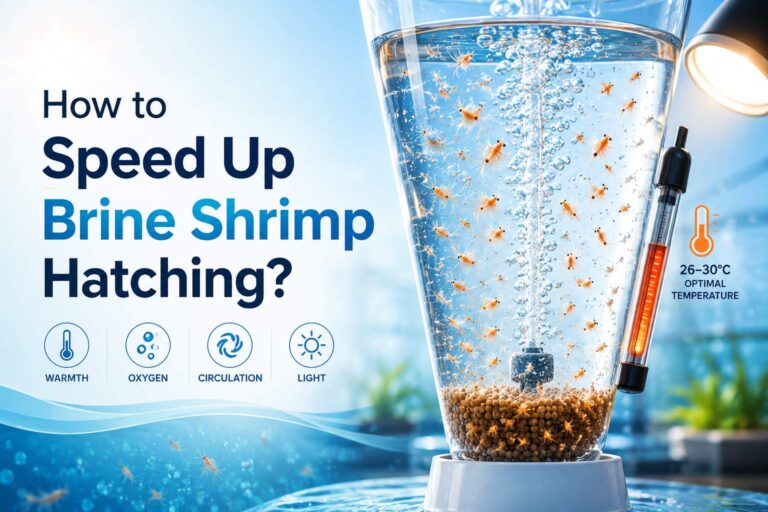
In general, warmer water helps brine shrimp eggs hatch faster. A suitable hatching temperature is usually around 25–28°C. At this range, the embryos inside the cysts become active and develop more quickly.
If the water is too cold, hatching will slow down. For example, at normal room temperature, the eggs may still hatch, but the process may take longer. This is why many users find that brine shrimp hatch slowly in winter or in rooms without heating.
However, higher temperature does not always mean better results. If the water becomes too hot, the eggs may be damaged and the hatch rate may drop. For most users, it is safer to use an aquarium heater or keep the hatching container in a stable warm area rather than using direct high heat.
A practical target:
Keep the hatching water around 26–28°C.
Avoid sudden temperature changes.
Do not place the hatching bottle directly under strong sunlight for uncontrolled heating.
Use a thermometer to check the real water temperature.
Stable warmth is better than extreme heat.
Use Proper Salinity
Brine shrimp eggs need saltwater to hatch. If the salinity is too low or too high, the hatching speed and hatch rate may be affected.
For many common hatching setups, users often prepare saltwater around 25–35 ppt. This is close to normal seawater strength and is easy to manage for aquarium and aquaculture use.
If the salinity is too high, the eggs may absorb water more slowly, which can delay hatching. If the salinity is too low, the environment may not be stable enough for good hatching results.
A simple practical method is:
Use clean water.
Add non-iodized salt, sea salt, or aquarium salt.
Mix completely before adding the eggs.
Keep the salinity consistent between batches.
Do not guess blindly if you are hatching large quantities. A refractometer or hydrometer can help improve consistency.
For small home hatching, small differences may still work. But for hatcheries, stable salinity is very important because it affects daily production planning.
Provide Strong and Continuous Aeration
Aeration is not only for “bubbles.” It has two important jobs.
First, aeration provides oxygen. Brine shrimp embryos need oxygen during development. If oxygen is not enough, hatching may slow down or fail.
Second, aeration keeps the eggs moving in the water. If the eggs settle at the bottom, some of them may stay in low-oxygen areas. This can cause uneven hatching and lower results.
For faster and more even hatching, the eggs should stay suspended in the water, not pile up at the bottom or float dry on the surface.
A good hatching setup should have:
Continuous aeration
Enough water movement to keep eggs suspended
No dead corners at the bottom
A clean air tube or air stone
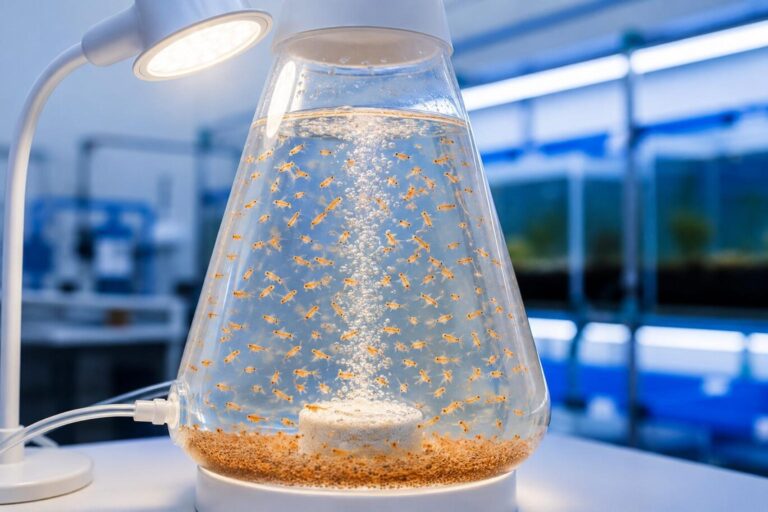
For small hatching bottles, a simple air pump is usually enough. For larger production, cone-shaped hatching tanks are better because they help keep the eggs moving evenly and make harvesting easier.
Add Light During the Early Hatching Stage
Light can help trigger the hatching process, especially during the early stage after the eggs are hydrated.
This does not mean the eggs need very strong light all the time. But a stable light source near the hatching container can help improve hatching consistency.
For simple use, you can place an LED lamp near the hatching bottle. The goal is to provide steady light, not to overheat the water.
Good practice:
Use continuous or long-period light during hatching.
Avoid using a lamp that makes the water too hot.
Keep the light position stable from batch to batch.
Light also helps during harvesting because newly hatched nauplii are attracted to light. After turning off aeration and letting shells separate, you can use light to gather the nauplii in one area.
Keep pH Slightly Alkaline
Brine shrimp eggs usually hatch better in slightly alkaline water. A pH around 8.0–8.5 is often considered suitable.
If the pH is too low, hatching may slow down. This can happen when using soft water or when hatching at high egg density, because the water condition can change during incubation.
For small users, this problem may not be obvious. But for hatcheries or repeated daily hatching, checking pH can help explain why one batch hatches faster than another.
If needed, sodium bicarbonate can be used carefully to help buffer the water. The purpose is not to make the water “stronger,” but to keep the hatching environment stable.
Do Not Add Too Many Eggs in One Container
Many beginners think adding more eggs will produce more nauplii. But if the container is too crowded, hatching may become slower and less stable.
High egg density can reduce oxygen, increase waste, affect pH, and make it harder for all eggs to receive the same conditions. As a result, some eggs hatch earlier, some hatch later, and some may not hatch well.
For faster and more even hatching:
Do not overload the hatching bottle.
Use enough water volume.
Increase aeration when hatching more eggs.
Use multiple hatching containers if daily demand is high.
For commercial use, it is better to hatch eggs in planned batches rather than putting too many eggs into one small container.
Hydrate the Eggs Properly
Dry brine shrimp eggs need to absorb water before development starts. This hydration stage is important.
In the first hours after being placed in saltwater, the cysts absorb water and become active. If the eggs are not fully exposed to water because they float, stick together, or stay dry on the wall of the container, hatching will become uneven.
To improve hydration:
Add eggs after the salt is fully dissolved.
Make sure aeration starts immediately.
Avoid egg clumps.
Rinse down eggs stuck above the waterline.
Keep the eggs moving.
Good hydration helps the batch start developing at the same time, which leads to a more synchronized hatch.
Store Brine Shrimp Eggs Correctly Before Use
Storage condition has a direct impact on hatching speed and hatch rate.
Brine shrimp eggs are living dormant embryos. They look dry and inactive, but they can lose quality if exposed to heat, moisture, oxygen, or poor packaging for a long time.
For better performance:
Keep unopened eggs in a cool and dry place.
Avoid moisture after opening.
Seal the package tightly after each use.
Do not leave eggs in a hot warehouse or under sunlight.
For long-term storage, refrigeration may help maintain quality.
If eggs are stored poorly, even perfect hatching water cannot fully recover their performance.
Should You Use Decapsulated Brine Shrimp Eggs?
Decapsulated brine shrimp eggs have had the outer shell removed. In some cases, they may hatch more easily because the embryo does not need to break through the hard shell.
They also reduce the problem of empty shells entering larval tanks. This can be useful for hatcheries that need cleaner live feed.
However, decapsulation requires correct handling. If the process is not controlled well, the embryos can be damaged. For most normal users, high-quality dry cysts and correct hatching conditions are easier and safer.
For professional hatcheries, decapsulated eggs can be considered when the goal is cleaner feeding, faster preparation, or more controlled production.
Common Reasons Brine Shrimp Hatch Slowly
If your brine shrimp eggs hatch slowly, check these points first:
The water temperature is too low.
The salt level is not suitable.
Aeration is weak or uneven.
The eggs settle at the bottom.
The pH is too low.
The eggs are old or poorly stored.
Too many eggs are added to a small container.
The hatching container has dead corners.
Light is too weak during the early stage.
The salt or water contains unsuitable chemicals.
Most hatching problems are not caused by one single factor. Usually, slow hatching is the result of several small problems happening at the same time.
A Simple Fast Hatching Setup
For most small to medium users, the following setup can help speed up brine shrimp hatching:
Prepare clean saltwater at around 25–35 ppt.
Keep the temperature around 26–28°C.
Use strong continuous aeration.
Add a steady light source.
Keep pH around 8.0–8.5.
Avoid overcrowding the container.
Use fresh, high-quality brine shrimp eggs.
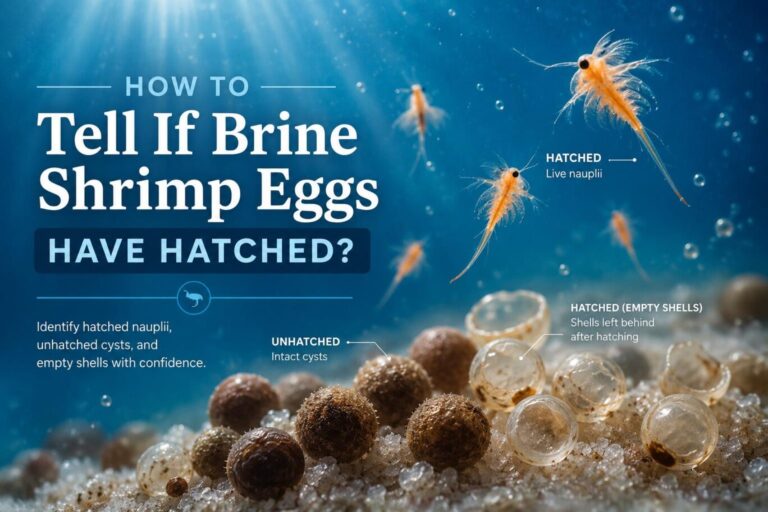
Harvest when most nauplii are newly hatched.
Under good conditions, many brine shrimp eggs can begin hatching in about 18–24 hours, depending on the egg batch. Some batches may take longer, especially if the temperature is lower or the eggs are older.
When Is the Best Time to Harvest?
Speed is important, but freshness is also important.
Newly hatched brine shrimp nauplii are most valuable as live feed because they still contain rich energy reserves. If they stay too long in the hatching water after hatching, they will gradually consume their own energy.
For fish fry and shrimp larvae, it is better to harvest when most nauplii have hatched and are actively swimming, instead of waiting too long for every last egg to hatch.
A good habit is to observe the batch at around 18 hours, 20 hours, 24 hours, and 30 hours. After several batches, you will understand the normal hatching rhythm of your eggs under your own conditions.
Final Thoughts
To speed up brine shrimp hatching, the most important thing is to control the environment, not to use extreme methods.
The best results usually come from stable temperature, proper salinity, strong aeration, suitable pH, enough light, correct egg density, and high-quality brine shrimp eggs. When these factors work together, hatching becomes faster, more even, and more reliable.
For aquaculture hatcheries, aquarium breeders, and live feed suppliers, choosing reliable brine shrimp eggs is the foundation of stable production. Good eggs save time, reduce waste, and help provide fresh nauplii when young fish or shrimp need them most.

 English
  Español
  Tiếng Việt
  Bahasa Indonesia
  ไทย
ไทย  Bahasa Melayu
  বাংলা
বাংলা  Nederlands
  Italiano
  Français
  Deutsch
  العربية